
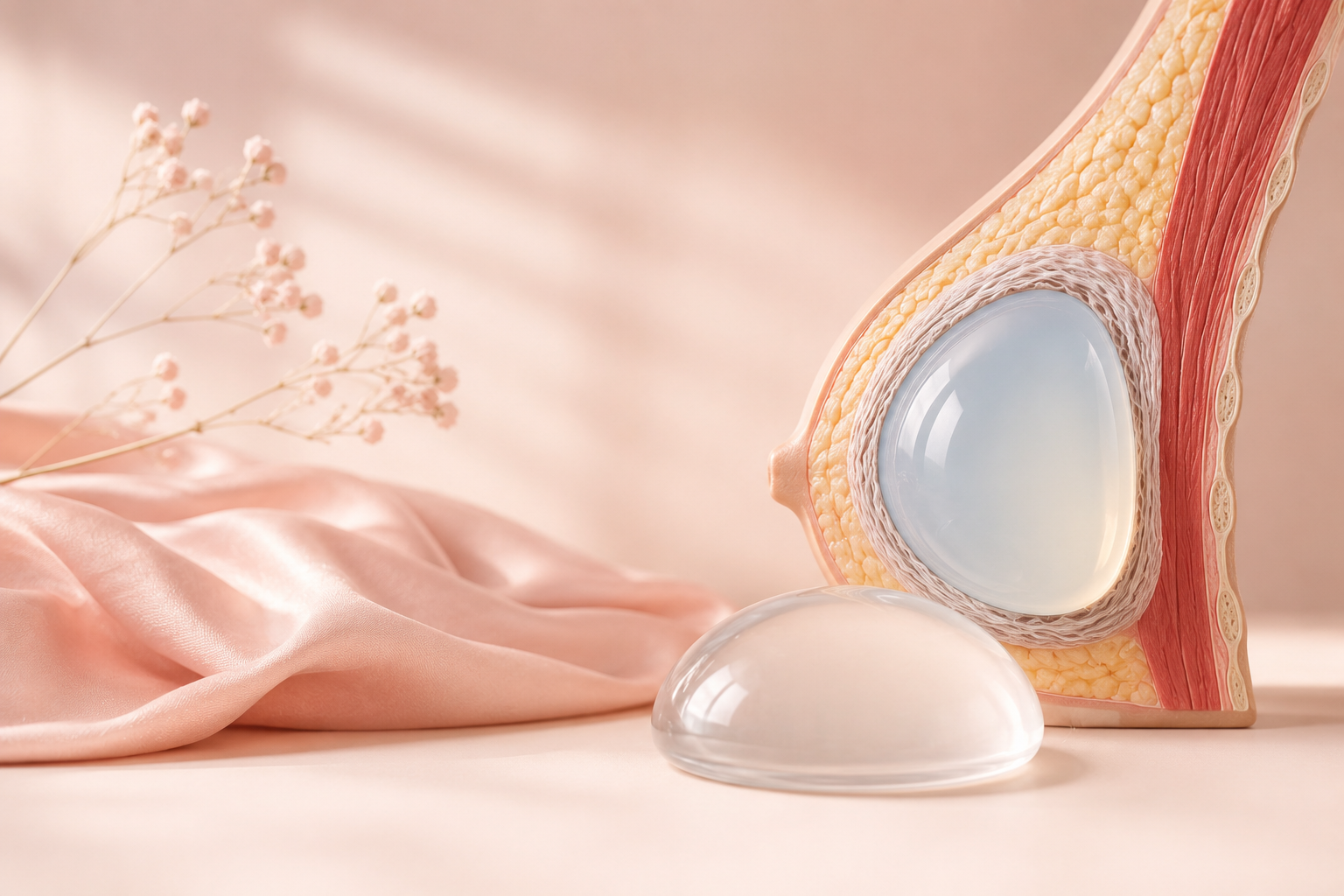
Capsular contracture is a breast implant complication in which the scar tissue capsule that naturally forms around every implant tightens and hardens, squeezing the implant and changing the shape, feel, or position of the breast. It affects roughly 1 in 10 breast augmentation patients over the lifetime of their implants, ranges from mild firmness to severe pain and visible distortion, and is graded on a four-point scale developed by Dr. James Baker. Not every case needs surgery. Understanding the early signs helps patients catch it while non-surgical options still work.
At BodEvolve Cosmetic, both Dr. Clayton Frenzel and Dr. Brian Holt treat capsular contracture regularly and guide patients through the full range of care from prevention to revision surgery when it becomes necessary.
What Is Capsular Contracture
When any foreign object is placed in the body, including a breast implant, the immune system responds by forming a thin layer of scar tissue around it. This capsule is normal and expected. In most patients, it stays soft and pliable, and the implant continues to feel natural.
Capsular contracture happens when that capsule tightens abnormally. The tissue thickens, contracts, and starts to squeeze the implant. Depending on how far it progresses, the breast can feel firmer than the other side, look higher or more rounded, sit visibly out of position, or become painful to the touch. It is not a rupture of the implant itself. The implant may still be perfectly intact. The problem is the tissue wrapped around it.
Baker Grades: The Four Stages of Capsular Contracture
Surgeons classify severity using the Baker classification, a four-grade scale that guides treatment decisions.
Grade 1 means the breast looks and feels normal. The capsule is soft. Most patients do not know they have any capsule formation at all, because this is the baseline healthy state.
Grade 2 is mild capsular contracture. The breast looks normal but feels slightly firm. Patients often notice this themselves before a surgeon does.
Grade 3 is when the breast starts to look abnormal. It may sit higher, appear rounder than the other side, or feel noticeably hard. Visible asymmetry is a hallmark of Grade 3.
Grade 4 is severe capsular contracture. The breast is hard, visibly distorted, and painful. Grade 4 almost always requires surgical correction.
Grades 3 and 4 are the ones that typically drive patients back to the surgeon. Grades 1 and 2 are often managed conservatively.
Early Signs of Capsular Contracture
Catching capsular contracture early gives you more options and better outcomes. The early signs are subtle and often develop gradually over weeks or months.
The first thing most patients notice is a change in firmness. The affected breast starts to feel harder than the other one. Not sore. Not swollen. Just firmer, especially when pressed.
Shape changes come next. The breast may sit slightly higher on the chest, look rounder or more spherical, or appear tighter across the top. Cleavage patterns can shift in tops that used to fit perfectly.
Discomfort follows in more advanced cases. Some patients describe it as a tight or pulling sensation. Others feel a dull ache that gets worse with certain arm movements or when lying on that side. Rib pain and referred shoulder pain occasionally show up in later stages.
If you notice any of these signs, schedule an appointment. Early evaluation opens doors that late evaluation closes.
What Causes Capsular Contracture
The exact trigger is still not fully understood, but research points to several contributing factors.
Low-grade bacterial contamination during surgery is one of the leading theories. Bacteria too few to cause obvious infection can still trigger an inflammatory response that thickens the capsule over time.
Implant surface and placement matter. Textured implants and smooth implants show different rates in studies. Placement below the muscle, called submuscular, generally shows lower capsular contracture rates than placement above the muscle, called subglandular, though both are used successfully for the right patient.
Hematoma or seroma after surgery, meaning collections of blood or fluid around the implant, increases the risk of capsule tightening later.
Radiation therapy after breast reconstruction dramatically raises the risk, which is why prevention strategies are especially important for patients who have undergone or will undergo radiation.
Implant rupture and silicone gel leakage can trigger a strong inflammatory response and lead to contracture.
Genetics also play a role. Some patients simply form thicker scar tissue than others, and this tendency can affect capsule behavior around any implanted device.
How Common Is Capsular Contracture
Studies estimate that roughly 8 to 15 percent of breast augmentation patients will develop some grade of capsular contracture over the lifetime of their implants. Most cases occur in the first two years after surgery, but late-onset contracture can develop 5, 10, or even 15 years later. This is one of the reasons implants are not considered permanent devices, and why our guide on how long breast implants last covers the signs that warrant a follow-up visit.
Rates vary by implant type, placement, and surgical technique. Saline versus silicone implants show slightly different profiles, and our comparison of saline vs silicone implants covers those differences in more depth.
How to Prevent Capsular Contracture
Prevention starts in the operating room and continues at home.
Choosing a board-certified plastic surgeon who uses sterile technique, no-touch implant insertion, and antibiotic irrigation of the pocket during surgery significantly reduces bacterial contamination risk. These are not add-on services. They are the surgical standard at experienced practices.
At home, several strategies help.
Implant massage in the early weeks after surgery, when specifically recommended by your surgeon, may help keep the pocket open. Not every surgeon recommends this for every implant type, so follow the instructions you were given rather than generic advice from forums.
Vitamin E and Singulair (montelukast) have both been used off-label as prevention strategies. Some surgeons prescribe them, others do not. The evidence is mixed but the safety profile is generally acceptable for short-term use under medical supervision.
Avoiding trauma to the chest during healing matters more than most patients realize. Heavy lifting, aggressive workouts, and sleeping on your stomach in the first weeks all put strain on the healing pocket.
Following your surgeon’s breast augmentation recovery instructions is the single most controllable prevention step.
Treatment for Capsular Contracture
Treatment depends on the Baker grade and how much the contracture is affecting you.
Grade 1 and mild Grade 2 are usually monitored. If it is not causing symptoms and not visibly changing the shape, aggressive treatment may not be necessary.
Grade 2 and early Grade 3 can sometimes respond to non-surgical treatment. Options include Singulair or Accolate (asthma medications that appear to soften capsule tissue in some patients), targeted massage, and Aspen ultrasound therapy, a non-invasive protocol using ultrasound waves to break down thickened tissue over a series of sessions. These do not work for everyone, but they can delay or avoid surgery when they do work.
Grade 3 with symptoms and Grade 4 typically require surgery. The two main surgical options are capsulectomy, which removes the entire capsule, and capsulotomy, which releases the tight tissue without removing it. Capsulectomy is more common today because it addresses the problem more definitively. Implants are usually replaced at the same time, either with the same type or a different one based on what contributed to the original contracture.
Cost and Insurance
Cosmetic revision for capsular contracture is not typically covered by health insurance, though reconstructive cases after mastectomy may be handled differently. Our page on whether insurance covers plastic surgery explains where the line falls.
Some implant manufacturers, including Allergan, Mentor, Motiva, and Sientra, offer warranty programs that provide replacement implants and partial financial support for capsular contracture correction within specific timeframes. Ask your surgeon which warranty applies to your implants.
Revision surgery cost varies with complexity, and our overview of how much plastic surgery costs puts revision pricing in context alongside primary procedures.
Capsular Contracture and Breastfeeding
Patients often ask whether capsular contracture affects future pregnancy or breastfeeding. The presence of a capsule alone does not typically interfere with milk production. Advanced contracture that has distorted the tissue may complicate things, and our article on breastfeeding after breast augmentation covers what to plan for.
When to Call Your Surgeon
Do not wait for symptoms to become severe. Call your surgeon if you notice new firmness on one side, a shape change that does not resolve within a week or two, new pain that was not present before, or visible asymmetry that developed after your initial healing period.
Early evaluation almost always means more treatment options, better outcomes, and lower cost. Late evaluation usually means surgery.
BodEvolve Cosmetic serves patients across Arlington, Richardson, Dallas, and Texarkana. If you have concerns about capsular contracture or want a second opinion on symptoms you are experiencing, schedule a consultation with Dr. Frenzel or Dr. Holt for a personalized evaluation.
