
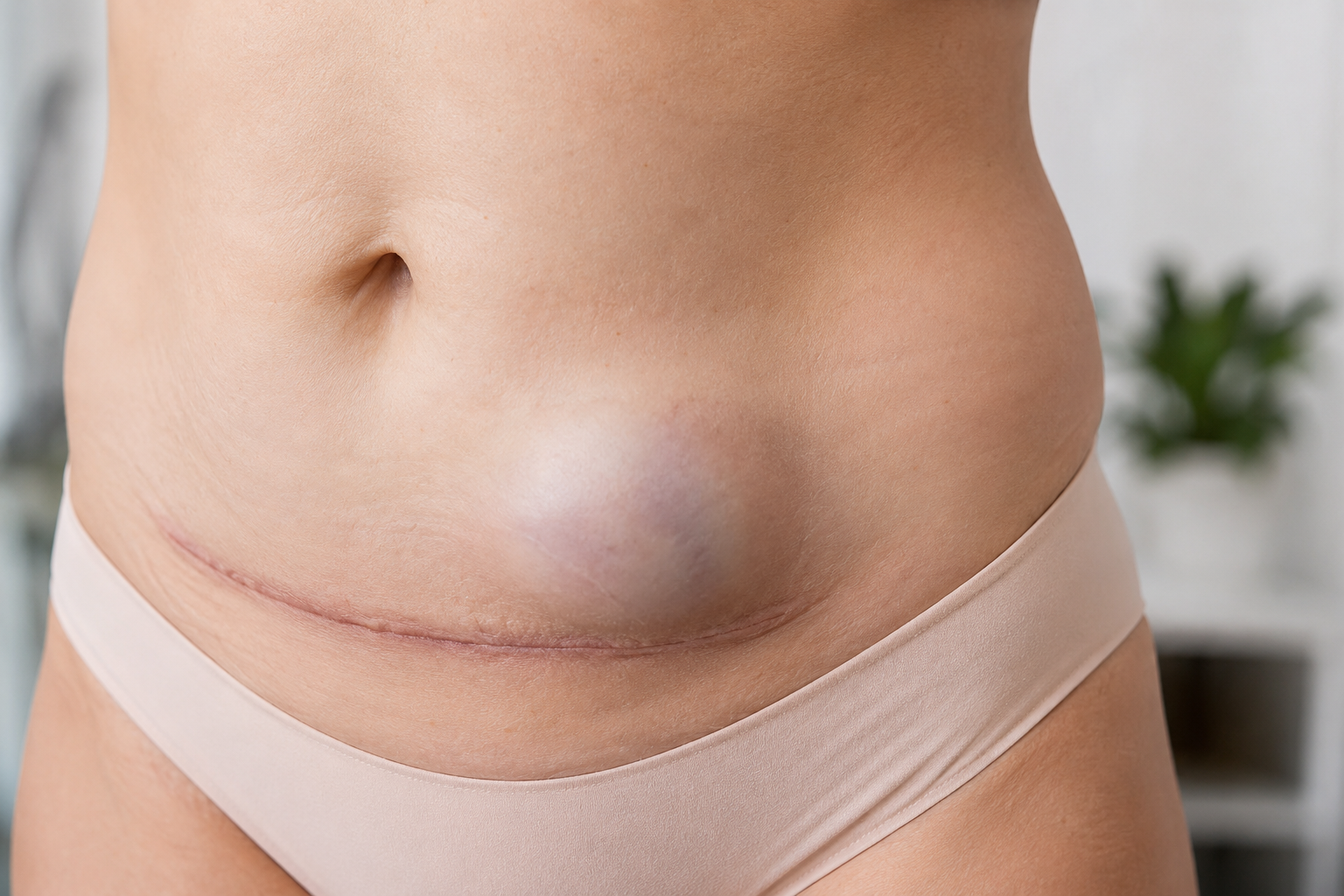
Seroma after tummy tuck is a collection of clear yellow fluid that builds up under the skin in the space left behind after surgery, most often in the lower abdomen. It is one of the most common complications following abdominoplasty, affecting roughly 5 to 15 percent of patients even with modern techniques. A seroma typically appears between week 2 and week 6, after your surgical drains have been removed, and shows up as a soft swollen area that feels squishy or wave-like when pressed. Most small seromas absorb on their own with continued compression garment use and rest. Larger or persistent seromas need to be drained in the office with a small needle. Left untreated, a seroma can harden into a pseudobursa or become infected, so calling your surgeon at the first sign is always the right move.
What is a Seroma After Tummy Tuck?
A seroma is a pocket of clear or straw-colored serous fluid (a mix of plasma, lymph, and inflammatory fluid) that collects in the empty space between the skin and the abdominal wall after a tummy tuck. During abdominoplasty, the surgeon lifts a large flap of skin off the underlying muscle. As that space heals, the body fills it with fluid until the tissues reattach. Surgical drains handle most of that fluid during the first 1 to 2 weeks. When fluid keeps producing after the drains come out, a seroma can form.
Seromas are not the same as hematomas. A hematoma contains blood and appears earlier (usually within 24 to 72 hours). Seromas contain clear yellow fluid and appear later, typically between week 2 and week 6.
What Causes a Seroma After Tummy Tuck?
Several factors contribute to seroma formation after abdominoplasty:
- Large dead space: The bigger the area lifted during surgery, the more space fluid can collect in. Full and fleur-de-lis tummy tuck procedures carry higher seroma risk than mini tummy tuck surgery.
- Early drain removal: Drains taken out before output drops below 30 mL per 24 hours increase risk significantly.
- Too much activity too soon: Movement stretches healing tissue and delays the tissue layers from sticking back together.
- Combined procedures: Adding aggressive liposuction to the abdomen with a tummy tuck raises seroma risk.
- Patient factors: Higher BMI, diabetes, smoking, and older age all increase risk.
- Skipping compression: Compression garments hold tissue layers together while they heal. Removing the garment too early is one of the most common causes.
Signs of Seroma After Tummy Tuck
Recognizing the signs early lets you catch a seroma before it grows large enough to need drainage. Common signs include:
- A soft, swollen area of the lower abdomen that feels squishy or fluid-filled
- A wave-like sensation when you press one side and feel movement on the other (called fluid wave)
- Swelling that gets worse rather than better after week 2
- Feeling of heaviness, pressure, or fullness in the lower belly
- Skin that looks stretched, shiny, or discolored over the swollen area
- Fluid leaking from an incision line
- Asymmetric swelling that is much worse on one side
Fever, warmth, redness spreading outward, or foul-smelling drainage suggest infection rather than a simple seroma and need urgent attention.
Seroma Swelling After Tummy Tuck: When is it Normal?
Some swelling after tummy tuck surgery is completely normal and can last 3 to 6 months. General swelling is diffuse, firm, and improves gradually week to week. Seroma swelling is different. It appears in a localized area, feels soft and squishy rather than firm, and often gets worse rather than better over time. If swelling is improving, then suddenly worsens around week 2 to 4, that is a red flag.
Seroma After Tummy Tuck Pictures: What Does It Look Like?
Patients often search for seroma after tummy tuck photos to compare their swelling to what a seroma actually looks like. A typical seroma appears as an obvious rounded bulge on one side or in the middle of the lower abdomen, sometimes described as looking like a small water balloon under the skin. The skin overlying it may look tight and shiny. Rather than relying on internet images, take a clear photo of your abdomen in good lighting and text it to your surgeon’s office. They can quickly tell you whether what you are seeing needs evaluation.
How to Drain a Seroma After Tummy Tuck
A seroma should never be drained at home. The procedure needs sterile technique to prevent infection, and only a trained clinician should perform it. In the office, your surgeon will clean the area, numb the skin, and use a small needle and syringe (a process called aspiration) to remove the fluid. The procedure takes 5 to 10 minutes and feels similar to a regular injection. Most seromas need 2 to 5 aspiration sessions over several weeks before they stop refilling.
For large or stubborn seromas, your surgeon may place a small temporary drain, inject a sclerosing agent (which irritates the walls of the cavity so they stick together), or in rare cases perform a minor surgical revision.
How to Get Rid of Seroma After Tummy Tuck
Treatment depends on size. Small seromas often absorb on their own within 2 to 4 weeks with these steps:
- Wear your compression garment 24/7 as prescribed
- Rest and limit activity that stretches the abdomen
- Keep follow-up appointments so your surgeon can monitor size
- Stay well hydrated
- Avoid heat exposure (hot tubs, saunas) that increases inflammation
Medium and large seromas need in-office aspiration. Persistent seromas that refill after multiple aspirations may need a drain, sclerotherapy, or surgical revision.
How Long Does Seroma Last After Tummy Tuck?
Most seromas resolve within 4 to 8 weeks with appropriate treatment. Small seromas caught early may absorb in 2 to 3 weeks. Larger seromas requiring multiple aspirations can take 6 to 12 weeks to fully resolve. Rarely, a chronic seroma persists for months and hardens into a pseudobursa (a fluid-filled sac lined with scar tissue). Pseudobursas usually require surgical removal.
Seroma Pseudobursa After Tummy Tuck
A pseudobursa is what happens when a seroma is left untreated for months. The body forms a thickened lining around the fluid pocket, similar to how a joint bursa is structured. Once a pseudobursa forms, aspiration alone rarely fixes it because the lining keeps producing fluid. Treatment requires surgical excision of the entire capsule. This is why early treatment of a suspected seroma is important, and why skipping follow-up appointments after a tummy tuck is not a good idea.
Hematoma or Seroma After Tummy Tuck: How to Tell
The two are often confused but behave very differently:
- Hematoma: Blood collection. Appears within 24 to 72 hours. Purple or dark bruising, firm swelling, more painful, rapidly expanding. A hematoma is a surgical emergency.
- Seroma: Fluid collection. Appears between week 2 and week 6. Soft squishy swelling, mildly uncomfortable, slower to grow.
If swelling appears in the first 3 days and is firm, painful, or expanding, that is a hematoma and needs immediate evaluation, not a seroma.
How to Prevent Seroma After Tummy Tuck
Prevention is the best strategy. These steps significantly reduce risk:
- Wear your compression garment 24/7 for the full duration your surgeon prescribes. This is the single biggest factor.
- Limit activity strictly during weeks 1 through 4. No lifting over 5 pounds, no bending, no reaching overhead.
- Do not remove drains early. Let output drop below 30 mL per 24 hours before removal.
- Skip nicotine, alcohol, and unnecessary anti-inflammatory medications. These impair healing.
- Stay hydrated and eat adequate protein. Both support tissue healing.
- Book lymphatic drainage massage starting week 2. It helps fluid drain naturally through the lymphatic system.
- Choose a board-certified plastic surgeon experienced in techniques that reduce seroma risk, such as progressive tension sutures or quilting sutures that close the dead space directly.
- Consider a drainless tummy tuck if you are a candidate. These techniques use internal sutures to eliminate the space where fluid collects.
Seroma After Tummy Tuck Treatment: When to Call Your Surgeon
Call your surgeon’s office if you notice:
- Sudden increase in abdominal swelling after week 2
- A soft, squishy, wave-like area you can feel through the skin
- Fluid leaking from an incision
- Asymmetric bulging on one side of the lower abdomen
- Any fever, warmth, redness, or foul odor (possible infection)
Early treatment prevents small problems from becoming big ones. Do not wait for your scheduled follow-up if you notice these signs.
Reviewed by Dr. Clayton Frenzel, board-certified plastic surgeon at BodEvolve Cosmetic. Dr. Frenzel and perform tummy tuck, mommy makeover, and post-weight-loss body contouring procedures for patients across North Texas and the ArkLaTex region, using techniques designed to minimize seroma risk. Consultations are available at BodEvolve Cosmetic in Dallas, Arlington, Richardson, and Texarkana.
